What size triathlon bike do I need? How to size a tri or TT bike
By Trithings · 18 November 2026 · 6 min read
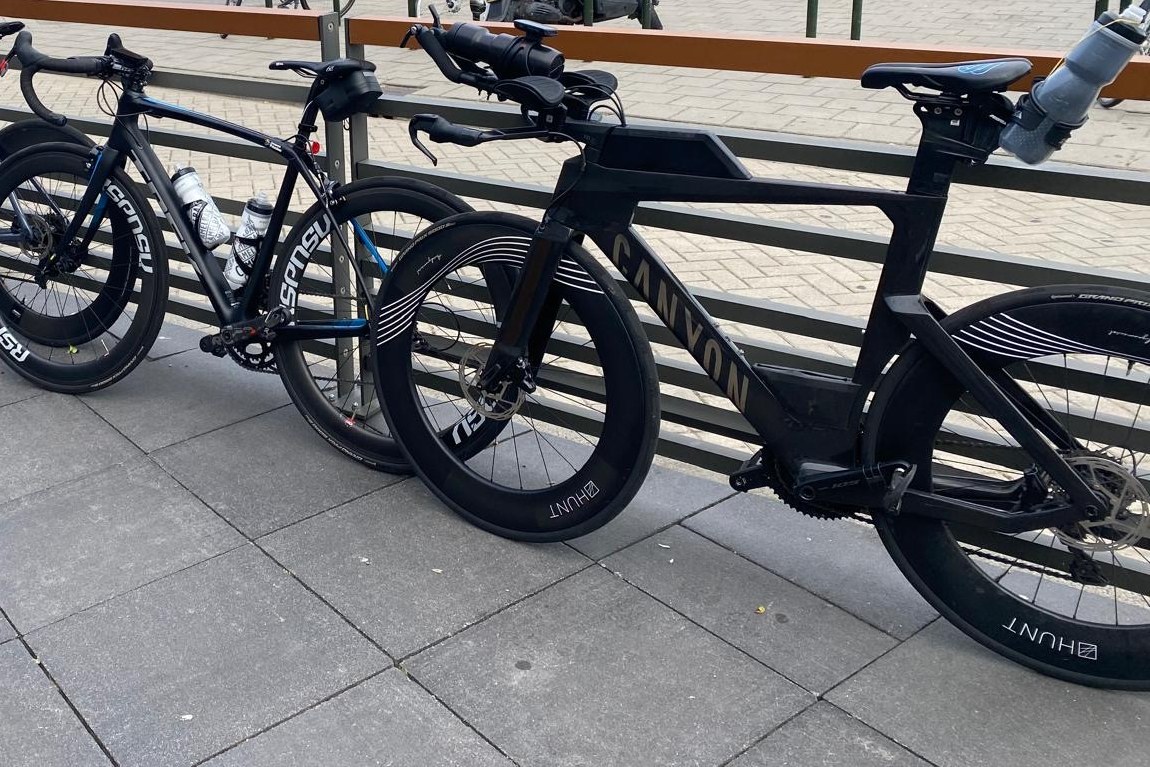
Photo: Brian McGuigan
The right size triathlon bike is the one whose armrests can be set to your position. Your height only gets you to a shortlist. Use it to find one or two likely sizes, then check your armrest height and length against each brand's fit table before you pay. Our bike size calculator does the first step in a minute, and the method below works the same for a time trial (TT) bike.
Why your road bike size does not carry over
Two numbers describe a frame. Stack is how high the top of the head tube sits above the bottom bracket (the axle the cranks turn on). Reach is how far it sits in front.
Letter sizes mean little between brands. A size M Canyon Speedmax CFR AXS has a stack of 489 mm and a reach of 438 mm. A size M Giant Trinity Advanced SL has 532 mm and 432 mm. That is 43 mm apart in height for the same letter.
Tri bikes also put you further forward. The Canyon Speedmax CFR Di2 has an 81 degree seat tube angle, where road bikes are typically nearer 73.5 degrees. So buy from the tri bike's own chart, never from the size of your road bike.
Step 1: make a shortlist from your height
These are our starting points for a rider with typical leg length, fitted to brands' own size charts. Allow about 20 mm either way:
- 165 cm: stack 492 mm, reach 401 mm
- 170 cm: stack 506 mm, reach 410 mm
- 175 cm: stack 520 mm, reach 419 mm
- 180 cm: stack 534 mm, reach 429 mm
- 185 cm: stack 547 mm, reach 438 mm
- 190 cm: stack 561 mm, reach 447 mm
Treat stack as the looser of the two, because armrest height can be changed a lot after you buy. Add your inside leg in the calculator for a closer answer and the size each brand's chart gives you.
Expect overlap. Canyon lists the Speedmax CFR Di2 in M for riders of 168 to 186 cm and in L for 180 to 196 cm, so a 182 cm rider could be sold either. Those two frames differ by 30 mm of stack and 23 mm of reach. Height cannot settle that.
Step 2: find your armrest numbers
On a modern tri bike, what matters is where your arms rest. Two measurements describe it:
- Pad stack: how high the armrests sit above the bottom bracket.
- Pad reach: how far in front of the bottom bracket they sit.
Triathlete's guide to tri bike fit numbers makes the point that these have largely replaced frame numbers when comparing new bikes. It also warns that brands do not all measure pad reach from the same spot: most use the back of the pad, some the middle. Check before you compare.
The best source is a bike fit on an adjustable jig. Fitter Phil Burt recommends exactly that order: find the position first, then look for frames that can match it. If you already ride aero bars comfortably, you can measure your current set-up as a rough guide.
Step 3: check the numbers against the fit table
Here is a worked example using Canyon's geometry sheet for the Speedmax CFR AXS. Say your fit gives a pad stack of 670 mm and a pad reach of 425 mm:
- Size M: pad stack 581 to 691 mm, pad reach 408 to 463 mm. Both fit.
- Size L: pad stack 619 to 729 mm, pad reach 430 to 484 mm. The stack fits, but the shortest reach is 5 mm too long.
Size L looks tempting because 670 mm sits near the middle of its stack range, which is where Triathlete advises you to aim. Reach rules it out, so M is the answer.
How much room you get varies by bike. Giant's guide gives 80 mm of armrest height adjustment on the Trinity. Trek quotes 115 mm of stack and 160 mm of reach adjustment on the Speed Concept. Cervélo says the stack of the P5 adjusts by up to 40 mm, and its product page has a calculator that takes your pad stack, reach and saddle height and shows which sizes work.
TT or tri set-up: decide before anyone cuts the fork
Some bikes come in two forms. Giant's fitting guide lists a lower TT set-up and a higher Tri set-up for the Trinity. On a size M, the armrest stack range is 624 to 704 mm for TT and 672 to 752 mm for Tri.
The fork decides which you have, and going from Tri to TT means cutting it, which cannot be undone. If you are not sure how low you will ride, keep the height until you have spent a season in the position.
How low should an age grouper go?
Lower is not automatically faster. Burt says stack is the number to get right first, because a position that is too low is hard to hold and closes the angle at your hips, which costs power.
A modelling study reported by 220 Triathlon, based on 19 time trial cyclists, found that a very low torso paid off at around 46 km/h and above. Below about 30 km/h, a more upright torso of around 24 degrees came out better. Many age groupers ride much closer to the second figure, and you still have to run afterwards. Choose a size that lets you sit a little higher.
Check the race rules
For non-drafting age-group races, World Triathlon's rules (section 5.2) allow the front of the saddle to sit up to 5 cm in front of the bottom bracket and up to 15 cm behind it. Aero bars must not stick out past the leading edge of the front wheel.
Draft-legal age-group races are different: only traditional drop handlebars are allowed, with no clip-ons, so a tri bike is out. Check your race's own rules too, as organisers can differ.
Not ready to buy? Start with clip-ons
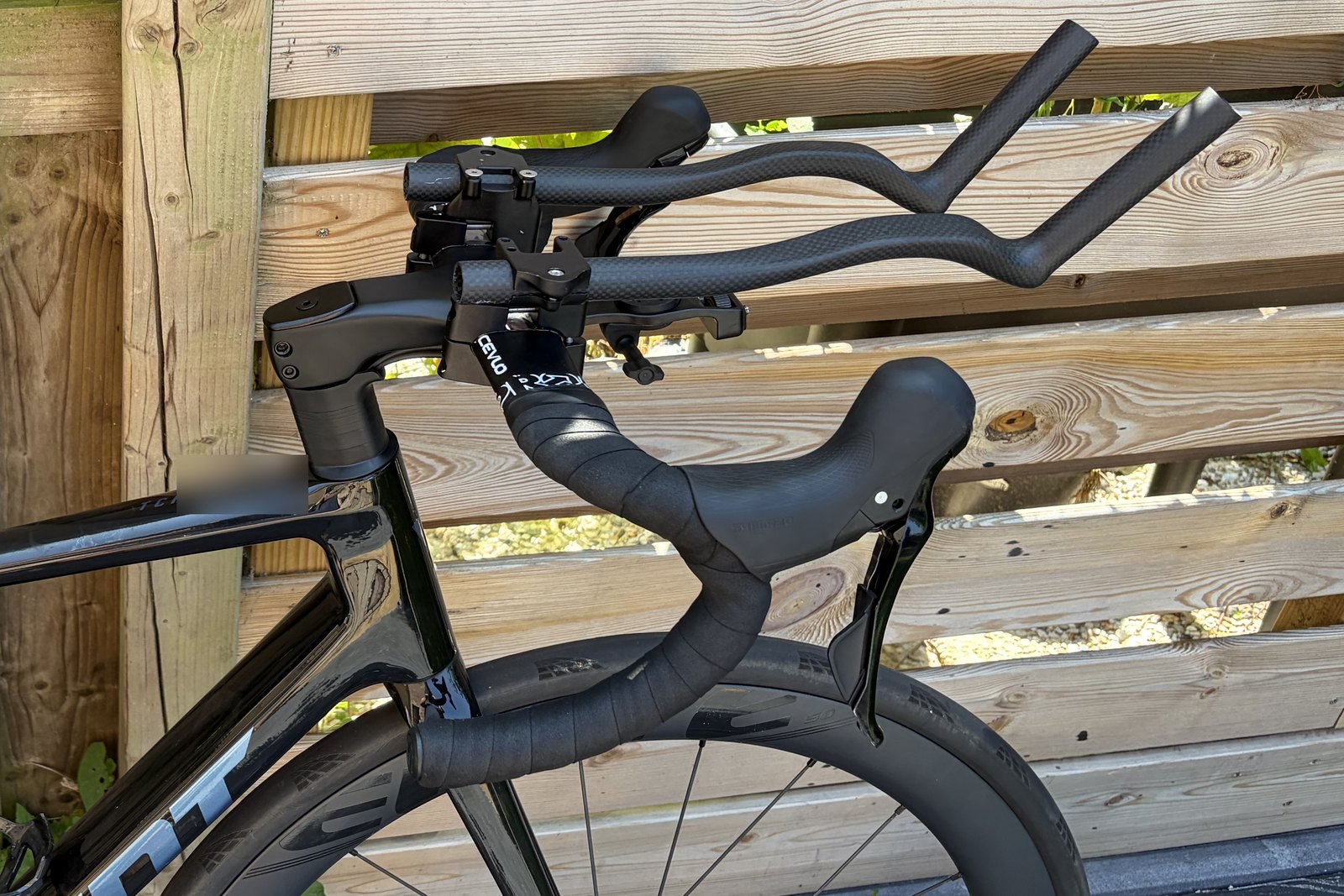
Clip-on bars let you try the position on your road bike. Burt notes they are rarely ideal, because a road frame is not designed to put your elbows that far forward, but they will show you how low you can comfortably hold. They need not cost much either: the aero bars in Brian's AliExpress upgrades review were listed at about €70.
Before you pay
- Get your pad stack and pad reach from a fit, or measure your current set-up.
- Compare them with the fit table for that exact model and year. Canyon lists a size M stack of 481 mm for the Speedmax CFR Di2 and 489 mm for the AXS.
- Pick the size that puts both numbers inside the range, with some room to change.
- Buying used? Find the geometry sheet for that model year and check the armrest parts are included.
Product links go to the maker's or shop's own page. If one ever earns us a commission, it never changes what we write.